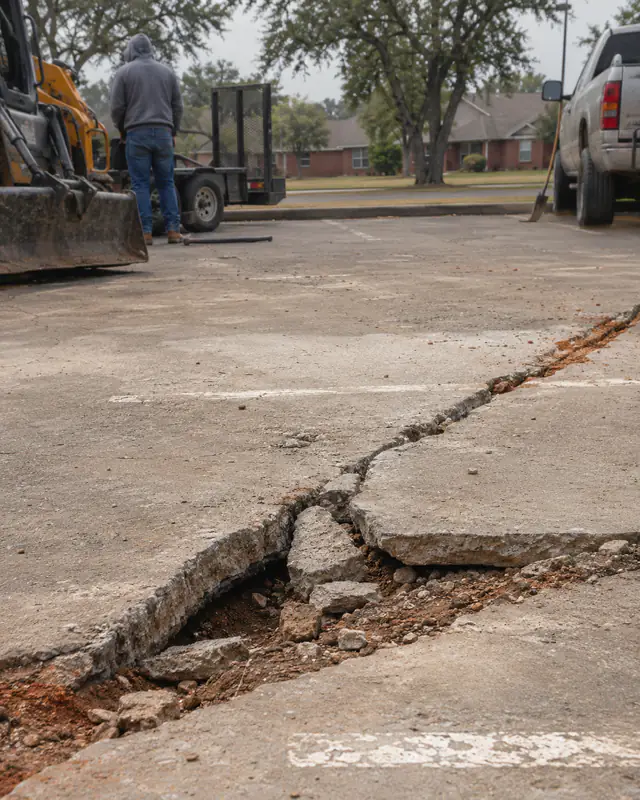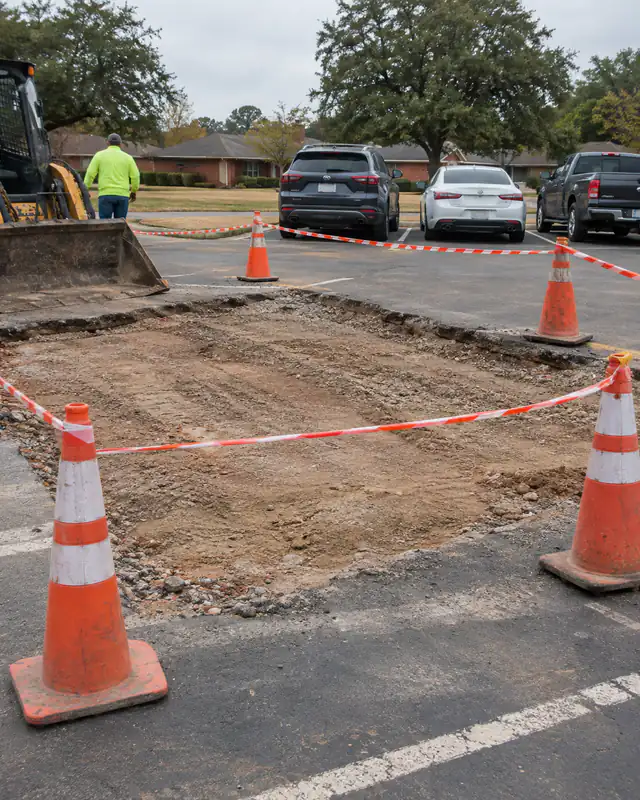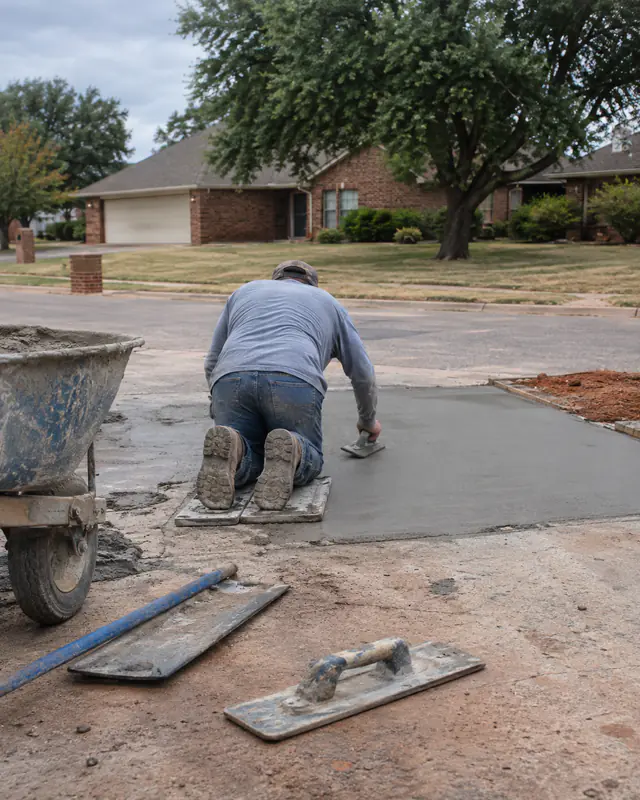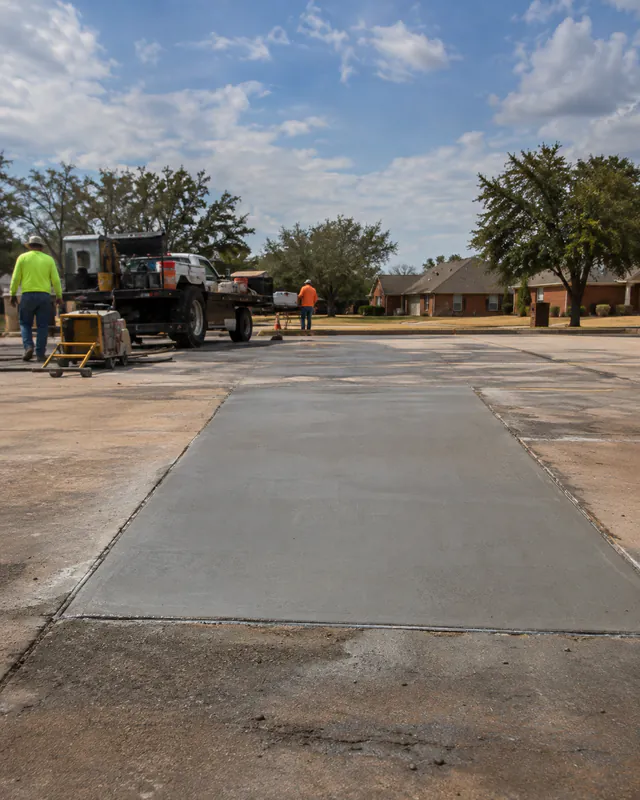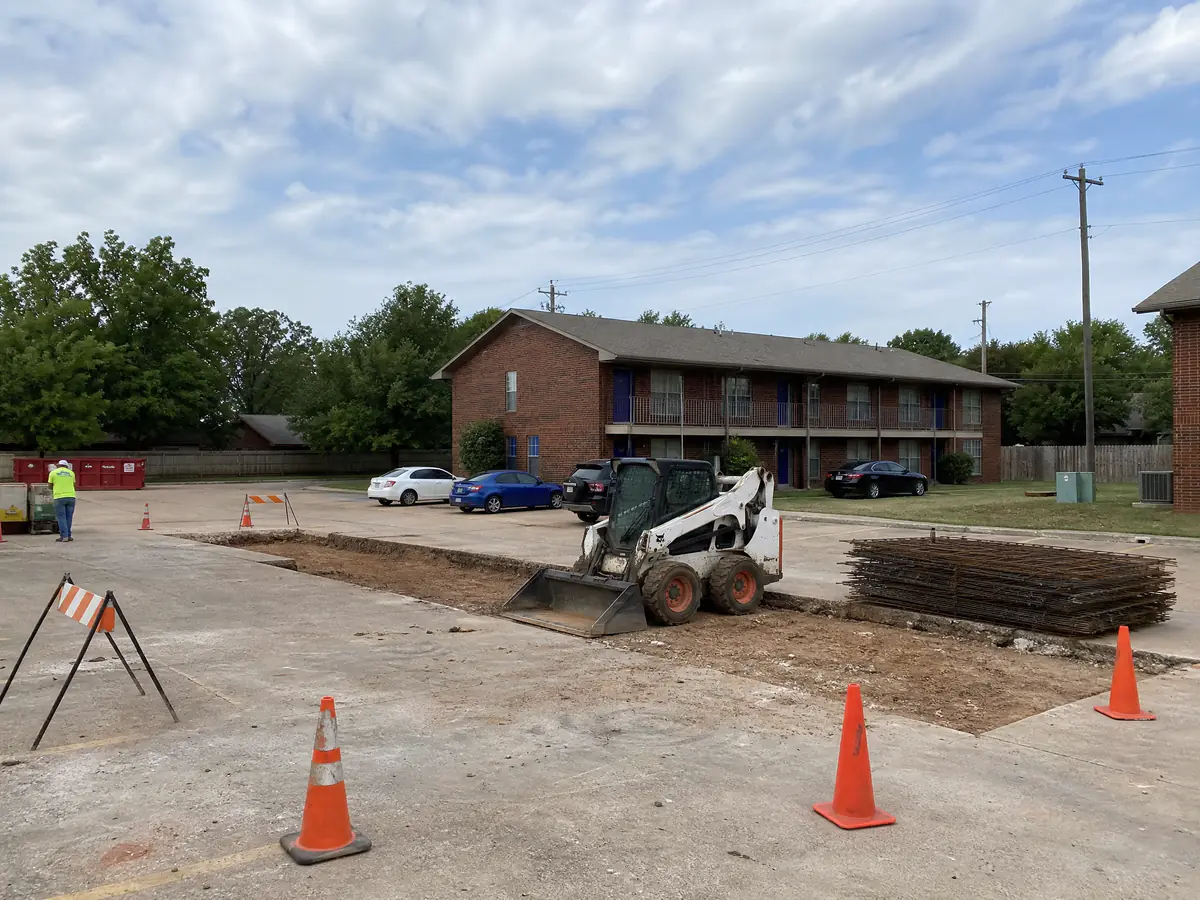
OKC Driveway Repair Co. does parking lot repair for small commercial properties in Oklahoma City: apartment complexes, churches, offices, clinics and retail pads. Parking lot repair here means fixing the sections that failed, such as broken concrete panels, potholes, sunken drive lanes and trip edges on walkways, rather than repaving the whole lot. Every site is quoted after a walk-through, with each repair priced on its own line so you can budget in phases.
What happens on the site walk
- Every defect listed, with its location, size and a photo.
- Ranked by risk. Trip edges on walkways and entrances first, then failures in drive lanes, then cosmetic work.
- Cause noted. Ponding, a failing curb, a dumpster pad that takes truck loads, or a tree line along the lot.
- A written, itemized quote your board, owner or insurer can read.
Trip hazards come first
A lifted or sunken edge on a walkway is a liability long before it is a pavement problem. The 2010 ADA Standards allow a vertical change of up to ¼ inch on an accessible route (§303.2), and changes between ¼ and ½ inch must be beveled no steeper than 1:2 (§303.3). Anything taller has to be removed.
The fix depends on why the edge is there. If one panel is high and otherwise sound, we grind it to a bevel, often in a few hours. If a panel has sunk, we lift it back to grade. If it is broken or root-heaved, it comes out and is re-poured. We cone and tape off any hazard on the first visit while the repair is scheduled.
Concrete and asphalt lot repairs
Concrete panels in drive lanes and at dumpster pads are saw-cut at the joints, the base is rebuilt with compacted stone, and new panels are doweled into the old ones. Dumpster pads and entrances, where trucks turn, get a thicker slab.
Asphalt failures are cut square and patched full depth, the same method as our asphalt driveway repair but at lot scale, with hot-pour crack filling across the rest of the surface. When a lot is due for sealcoating, we schedule the patching first so the sealer goes on a sound surface.
Drainage is usually the root cause. Water ponding in stalls softens the base and turns into potholes. We note where regrading, a curb cut or a drain would stop the cycle.
Keeping the lot open
Lots can’t shut down for a week. We phase the work one section at a time, keep entrances open, and mark work zones with cones and barricades. Grinding, crack sealing and small asphalt patches can be done in the evening or on weekends. Concrete pours need daylight and seven days before cars cross them, so we plan those sections around your busiest hours.
We repair and replace sections of small lots. We don’t repave or stripe large commercial lots; when a lot needs that, we tell you and suggest getting a paving company’s bid.
Paying for it
Each repair is its own line on the quote, so you can do the safety items now and the rest next budget year. Before-and-after photos and a short report come with the work for your records, board or insurer. If your lot has frequent claims or complaints, ask about a yearly walk-through to catch trip edges early.
What's included
- Site walk with a written, itemized repair list
- Repairs ranked by safety, then by cost
- Work phased so the lot stays open
- Cones, barricades and taped-off areas
- Concrete panels saw-cut, doweled and re-poured
- Asphalt failures cut square and patched full depth
- Trip edges ground or panels leveled
- Photo documentation for your records or insurer
Signs your lot needs attention
- Raised or sunken panels creating trip edges on walkways
- Potholes or alligator cracking in drive lanes
- Broken concrete at dumpster pads and entrances
- Water ponding in parking stalls
- A tenant, member or customer complaint about a trip hazard
Not sure which side of the line yours is on? The free driveway damage assessment takes about two minutes.
DIY patch vs the cheapest bid vs a driveway done properly
Most failed OKC drives didn't fail because of the concrete. They failed because of what's under it and what was skipped. Here's what to look for on any quote.
| What matters | DIY patch | Cheapest bid | Done properly |
|---|---|---|---|
| Base | Patches over whatever is there | Native clay graded flat, little or no stone | Soft clay dug out; 4–6 in. compacted crushed stone |
| Concrete | Bagged mix, hand-mixed, no air | Spec not on the quote | 4,000–4,500 psi air-entrained ready-mix, in writing |
| Thickness | Whatever the bags cover | 4 in., often thinner at edges | 5 in. with thickened edges |
| Reinforcement | None | Mesh lying on the dirt | #3 rebar on chairs; dowels into old concrete |
| Joints | None | Tooled late or skipped | Saw-cut within 24 h to ¼ depth, ~10 ft apart; ½ in. expansion joints |
| Curing | Left to dry | Left to dry | Membrane curing compound; no cars for 7 days |
| Permit at the street | Skipped | Often skipped | Pulled per OKC Code §50-116 |
| Quote | — | One number, verbal | Written, itemized, per square foot |