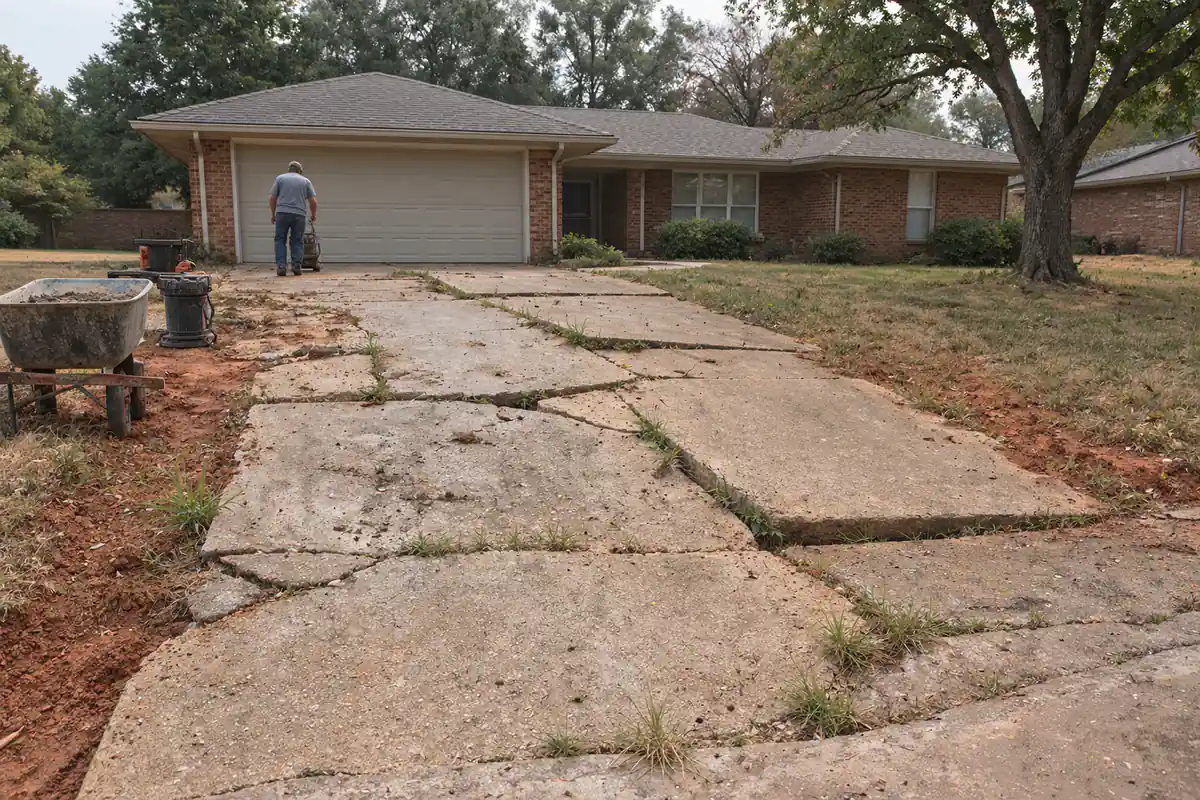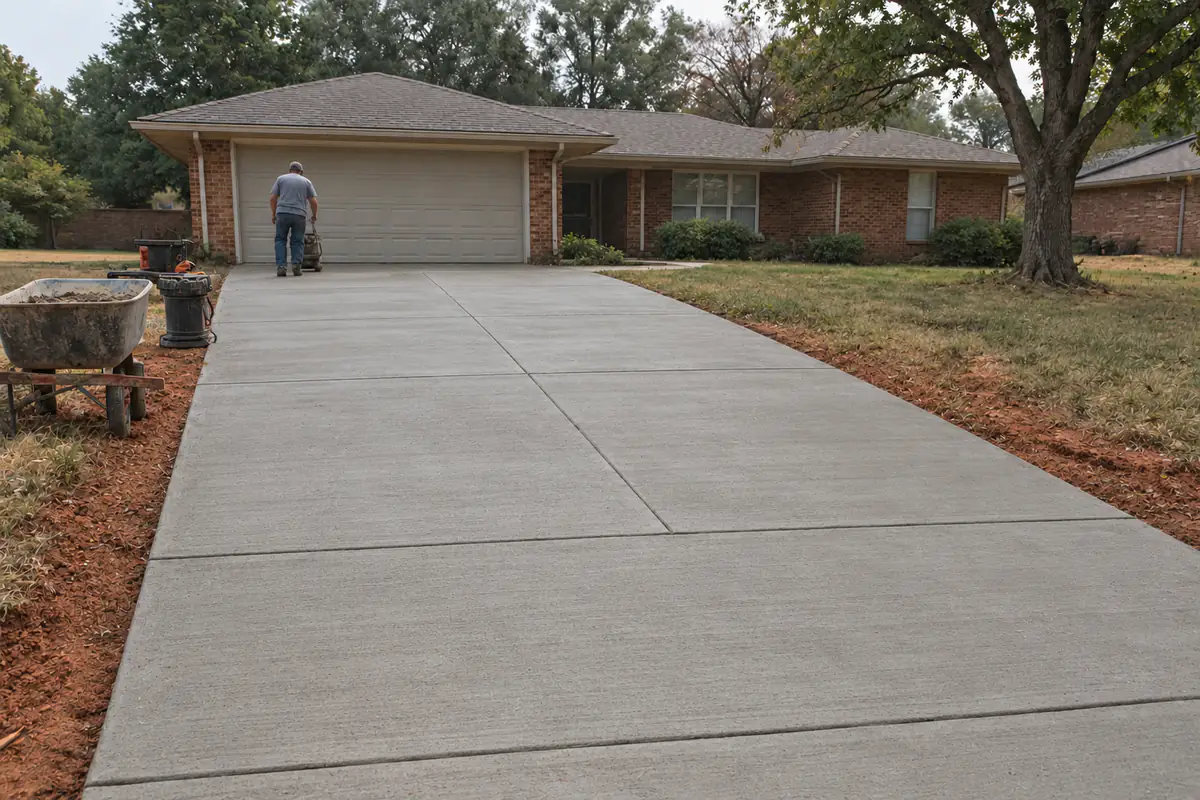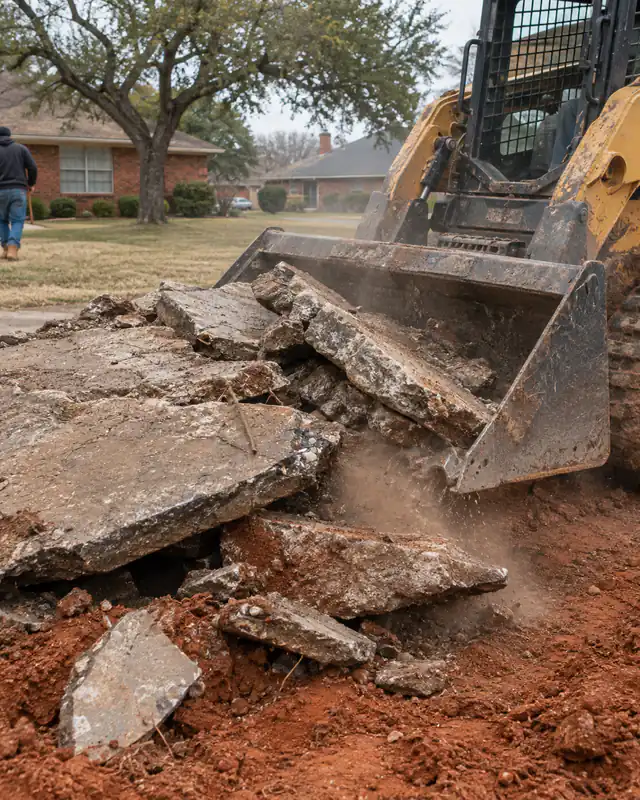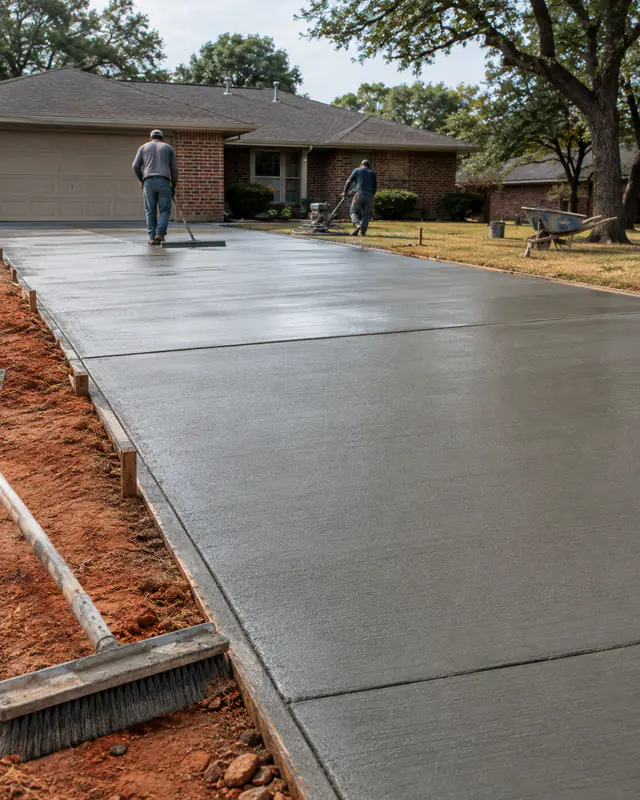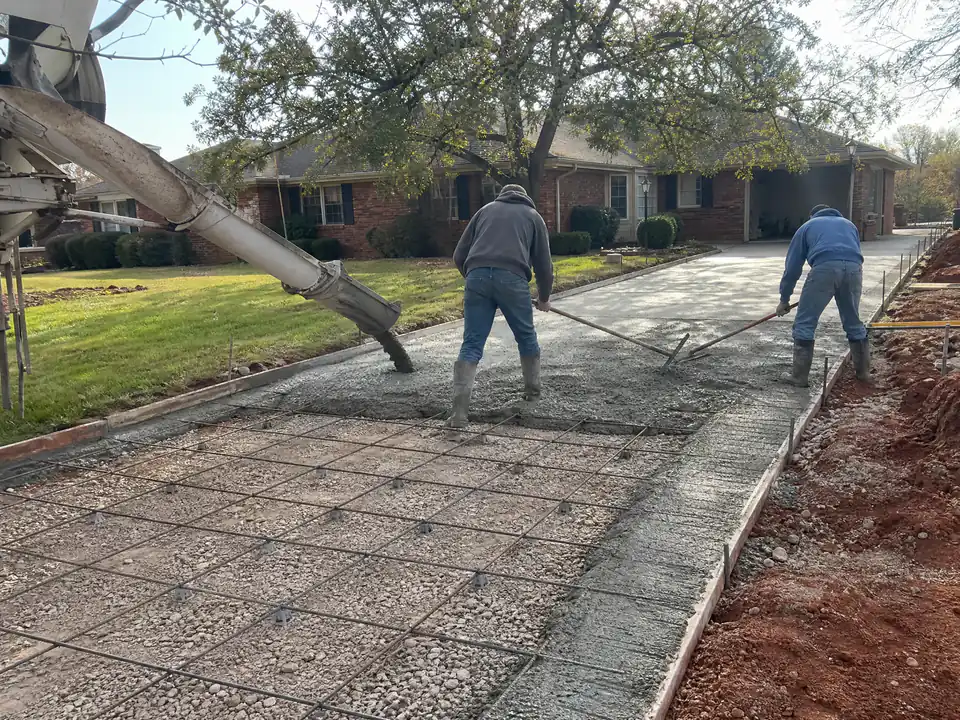
OKC Driveway Repair Co. is a driveway replacement contractor serving Oklahoma City and the surrounding metro. A full-depth driveway replacement means removing the old slab, fixing the ground it sat on, and pouring a new 5-inch, air-entrained concrete driveway. In Oklahoma City that typically runs $8 to $13 per square foot. We recommend replacement only when repair or leveling would not last. When fewer than a third of the panels have failed, we will tell you so and quote the repair instead.
What happens on the first visit
The estimate takes about 30 minutes, and you get the number in writing before we leave or by email the same day.
- Measure every panel. Area, thickness at the edges (we core or check at a broken edge), and slope toward the street and away from the garage.
- Find out why it failed. We probe the subgrade at sunken panels, look for pumped mud at the joints, and trace where the downspouts and side-yard runoff go. A new slab poured on the same problem fails the same way.
- Check the approach. If the job reaches the street, we note the curb condition and the right-of-way line, because that part needs a city permit.
- Price it line by line. Tear-out, base, thickness, psi, reinforcement, joints, finish and permit, each shown separately.
Why Oklahoma City driveways wear out
Most of the metro sits on red Permian clays. The USDA describes the Kirkland series as formed in clayey sediments over Permian shale, and the Oklahoma County soil survey rates it high for shrink-swell. In a dry summer the clay shrinks away from the underside of the slab. In a wet spring it swells back. Each cycle leaves voids under the concrete and lifts or drops panels at the joints.
The weather adds to it. Oklahoma City averages 71 days a year at or below freezing, but only about 8 of them stay below freezing all day (National Weather Service normals, 1991–2020). Water in cracks and joints freezes and thaws dozens of times each winter. Concrete that wasn’t air-entrained scales and flakes on top. Summer is the opposite extreme: the city’s record is 113°F, and it has seen as many as 63 days above 100°F in a single year (2011). Panels expand hard against each other in that heat, and if the expansion joints have rotted out, the edges crush and spall.
How we build a replacement driveway
The base
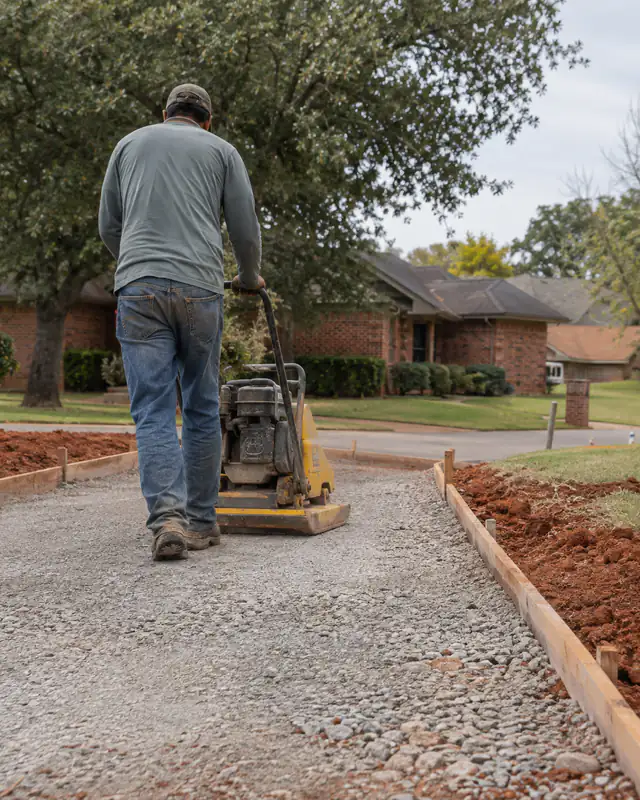
We proof-roll the exposed subgrade and dig out anything that pumps or ruts. That soft clay is replaced with 4–6 inches of compacted crushed stone, which gives the slab even support and lets water drain out from under it instead of soaking the clay.
The concrete
Our standard driveway is 5 inches of 4,000–4,500 psi air-entrained ready-mix, with thickened edges where cars turn. The International Residential Code (R402.2) requires air-entrained concrete wherever weathering is moderate or severe. ACI 318’s freeze-thaw class F2 sets 4,500 psi at a 0.45 maximum water-cement ratio. Going from 4 to 5 inches adds about 20 percent to concrete cost and nearly 50 percent to load capacity, according to the Tennessee Concrete Association figures cited by Concrete Network.
Steel, joints and curing
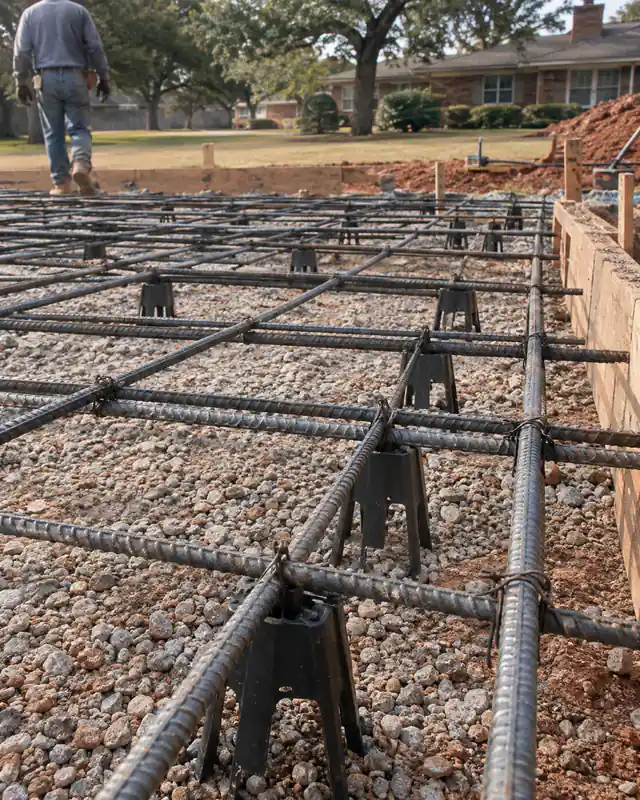
- #3 rebar on chairs at 18 inches on center, so the steel sits in the middle of the slab instead of on the dirt. Where new concrete meets old, we drill and set dowels.
- Control joints saw-cut within 24 hours to a quarter of the slab depth, at roughly 10-foot spacing, so the slab cracks where we want it to.
- ½-inch expansion joints at the garage, the sidewalk and the street. Oklahoma City’s own sidewalk specification (§50-103) calls for ½-inch expansion joints and 3,500 psi as a minimum. We build drives above that.
- Membrane curing compound sprayed on the day of the pour, as OKC Code §50-105 requires for driveways in the right-of-way, and no cars for 7 days.
Permits and the approach
Oklahoma City Code §50-116 says no one may “construct, replace or repair any sidewalk, curbs or driveways without a permit,” and §50-117 issues that permit only to a licensed sidewalk or paving contractor. In practice it applies to the approach in the city right-of-way, between the sidewalk and the street. When your replacement includes that section, we pull the permit and build the approach to the city’s grade stakes. Edmond, Norman, Moore and the other suburbs run their own permits, and we confirm each city’s current requirement before scheduling. More detail is in our Oklahoma City driveway permit guide.
Paying for it: insurance and payment
Homeowners insurance rarely pays for a driveway replacement. Standard policies exclude wear, settling, soil movement and root damage, which cause most of the failures above. Coverage is more likely after a sudden covered event, such as a tree falling on the drive or a vehicle breaking it, so check your policy and talk to your adjuster first. We document the damage with photos and measurements for your claim either way.
The estimate is free. Your payment schedule is written on the quote before the job is booked, and the price on the quote is the price unless you approve a change in writing. See the full breakdown in our 2026 Oklahoma City driveway replacement cost guide.
What's included
- Free on-site measurement and written, itemized quote
- 811 utility locate before any digging
- Saw-cut tear-out, haul-off and concrete recycling
- Subgrade proof-rolled and recompacted; soft spots dug out
- 4–6 inches of compacted crushed-stone base
- #3 rebar on chairs at 18 inches on center
- 4,000–4,500 psi air-entrained concrete, 5 inches thick
- Saw-cut control joints, ½-inch expansion joints and curing compound
Signs your driveway needs replacing
- Cracks wider than ¼ inch running across several panels
- Panels that have dropped, tilted or broken into pieces
- Surface scaling or spalling over more than a quarter of the drive
- Standing water that never drains off the slab
- A drive old enough that patching keeps failing (often 30+ years)
Not sure which side of the line yours is on? The free driveway damage assessment takes about two minutes.
DIY patch vs the cheapest bid vs a driveway done properly
Most failed OKC drives didn't fail because of the concrete. They failed because of what's under it and what was skipped. Here's what to look for on any quote.
| What matters | DIY patch | Cheapest bid | Done properly |
|---|---|---|---|
| Base | Patches over whatever is there | Native clay graded flat, little or no stone | Soft clay dug out; 4–6 in. compacted crushed stone |
| Concrete | Bagged mix, hand-mixed, no air | Spec not on the quote | 4,000–4,500 psi air-entrained ready-mix, in writing |
| Thickness | Whatever the bags cover | 4 in., often thinner at edges | 5 in. with thickened edges |
| Reinforcement | None | Mesh lying on the dirt | #3 rebar on chairs; dowels into old concrete |
| Joints | None | Tooled late or skipped | Saw-cut within 24 h to ¼ depth, ~10 ft apart; ½ in. expansion joints |
| Curing | Left to dry | Left to dry | Membrane curing compound; no cars for 7 days |
| Permit at the street | Skipped | Often skipped | Pulled per OKC Code §50-116 |
| Quote | — | One number, verbal | Written, itemized, per square foot |