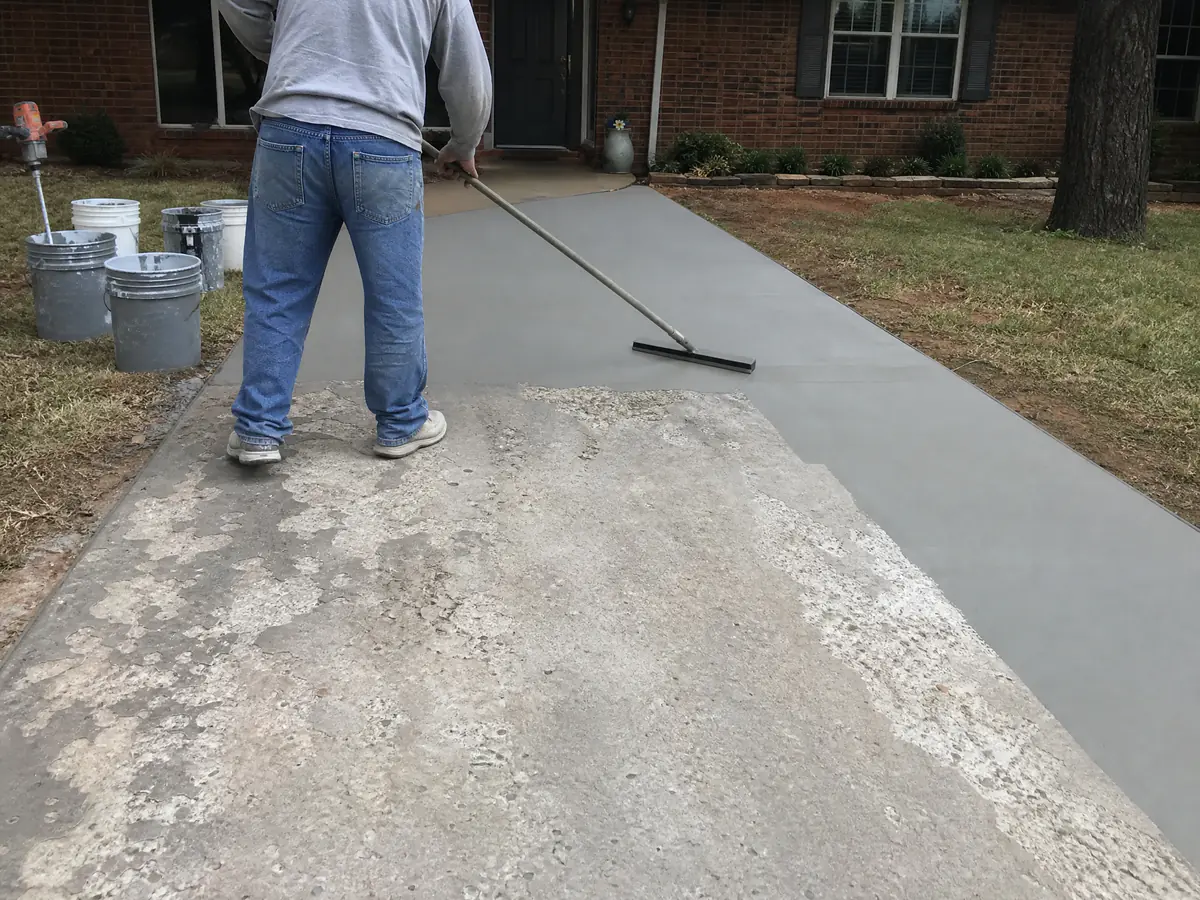
OKC Driveway Repair Co. provides driveway resurfacing in Oklahoma City for concrete that is structurally sound but worn out on top: flaking, scaling, pitting or covered in old patches. Driveway resurfacing applies a bonded, polymer-modified cement overlay about ⅛ to ½ inch thick, and costs about $3 to $7 per square foot, against $8 to $13 for full replacement. It is only worth doing on a slab that will hold it, so the first thing we check is the concrete underneath.
What happens on the first visit
- Sound the slab. We drag a chain or tap with a hammer to find hollow, delaminated areas that an overlay won’t stick to.
- Check the cracks and panels. Moving cracks and sunken panels will come back through an overlay.
- Look at drainage. A slab that holds water will lose any coating on it.
- Quote only if it will last. If the slab isn’t a candidate, we tell you and price the alternative.
Why Oklahoma City concrete flakes
Surface scaling is a freeze-thaw failure. Oklahoma City averages 71 days a year at or below freezing, but only about 8 days that stay below freezing all day (NWS normals). That means many winter days freeze overnight and thaw by afternoon. Water soaked into the top of the slab expands each time it freezes. Concrete with tiny entrained air bubbles has room for that expansion; concrete without them pops off in flakes.
That is why the International Residential Code (R402.2) requires air-entrained concrete for weathering exposure. Many older metro drives were poured without it, or were finished while bleed water was still on the surface, which weakens the top layer. De-icing salt and fertilizer spread on the drive make scaling faster.
How we resurface a driveway
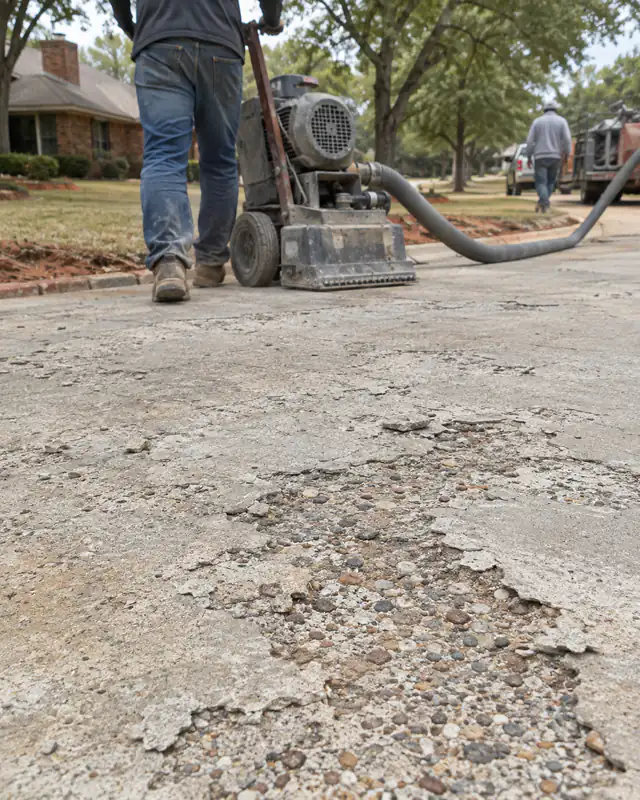
- Remove loose concrete. Anything flaking or hollow is ground or chipped out to sound concrete.
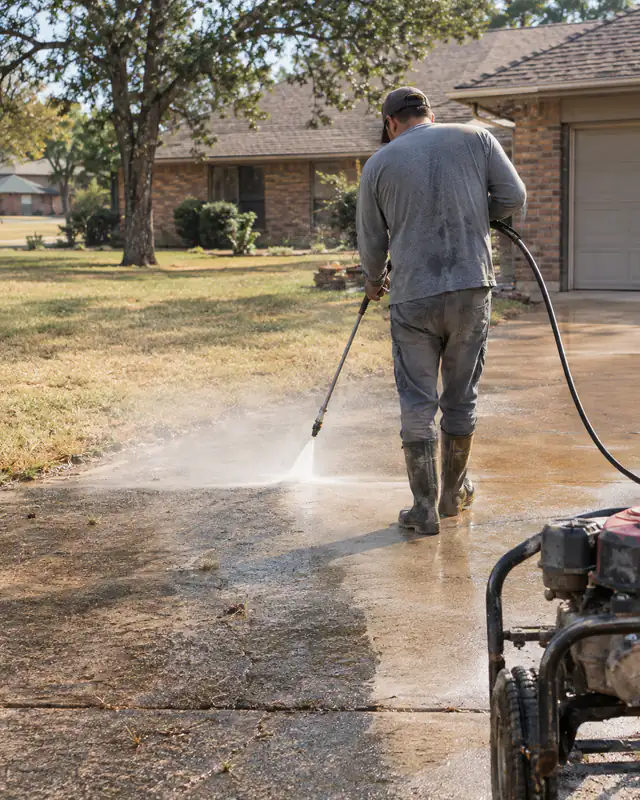
- Clean and profile. Pressure washing and grinding where needed give the surface a texture the overlay can grip.
- Repair cracks first. Moving cracks are routed and sealed as on our crack repair page, and deep spalls are patched.
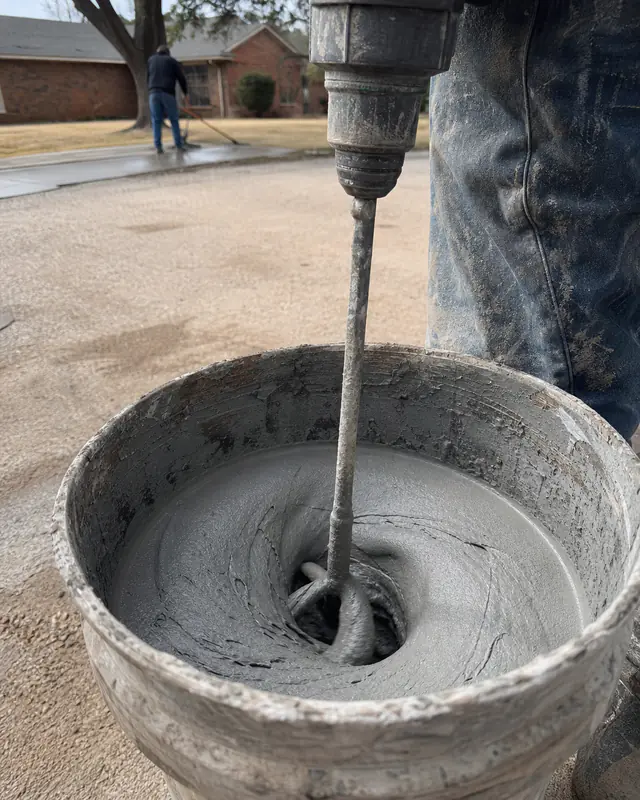
- Prime and overlay. A bonding primer goes down where the product calls for it, then the polymer-modified overlay is spread with squeegees and trowels.
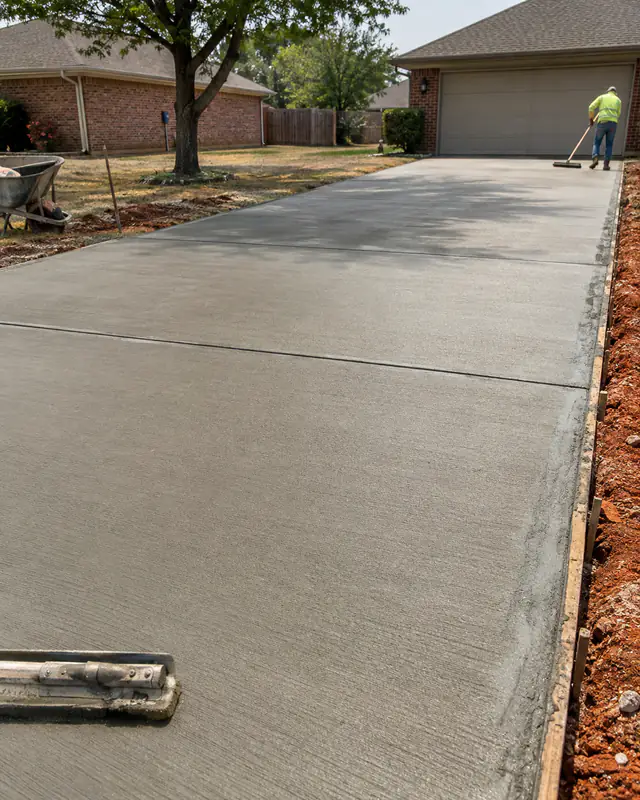
- Texture and keep the joints. We finish with a broom or swirl texture for traction and cut the control joints back open through the overlay so the slab can still move where it was designed to.
Foot traffic is fine the next day and cars after about two to three days, depending on temperature.
When we say no to resurfacing
An overlay can only be as stable as the concrete under it. We don’t resurface drives with sunken or rocking panels, cracks wider than ¼ inch, stepped cracks, large hollow areas, or a base that is washing out. Those drives need leveling, panel repair or replacement first. Our resurfacing vs replacement guide covers the dividing line.
Paying for it
A resurfacing quote is written per square foot with prep and crack repair as separate lines. Insurance treats scaling as wear, so it is almost always out of pocket. For a 480 sq ft two-car drive, expect roughly $1,450 to $3,350.
What's included
- Free on-site soundness check before quoting
- Loose and delaminated concrete removed
- Pressure-washed and profiled surface for bond
- Cracks routed and sealed before the overlay
- Bonding primer where the product calls for it
- Polymer-modified cement overlay, about ⅛–½ inch
- Broom or swirl texture for traction
- Existing control joints kept open through the overlay
Signs resurfacing will work
- Surface flaking or scaling with the slab underneath solid
- Pitting or exposed stone after a few winters
- Cosmetic stains or old patches you want covered
- Panels level with each other and not rocking
- Few cracks, and none wider than ¼ inch
Not sure which side of the line yours is on? The free driveway damage assessment takes about two minutes.
DIY vs the cheapest bid vs resurfacing done properly
An overlay bonds to whatever it is put on. The prep decides how long it lasts.
| What matters | DIY patch | Cheapest bid | Done properly |
|---|---|---|---|
| Soundness check | None | None | Slab sounded for hollow areas first |
| Prep | Hosed off | Pressure-washed only | Loose concrete removed, surface profiled |
| Cracks | Covered over | Covered over | Routed and sealed before the overlay |
| Material | Bagged patch or paint | Thin coating | Polymer-modified cement overlay |
| Joints | Covered | Covered | Kept open through the overlay |