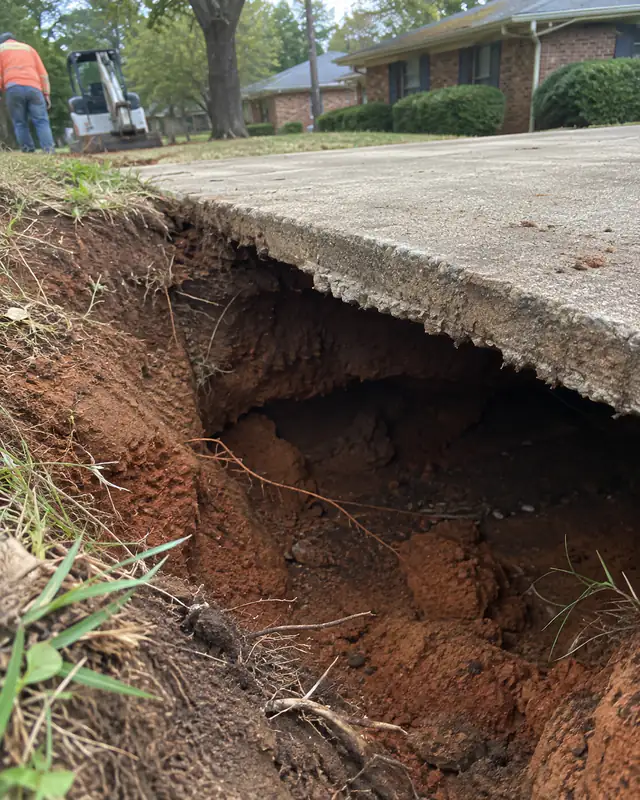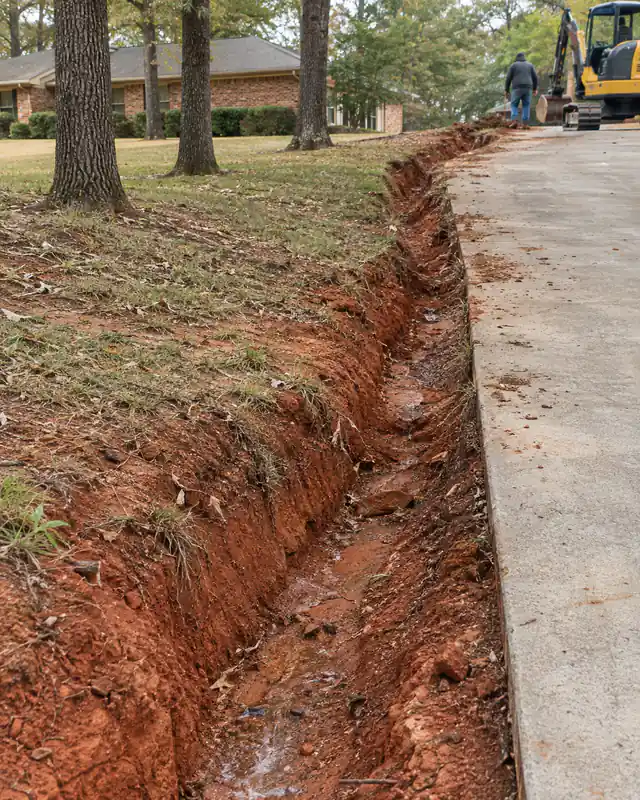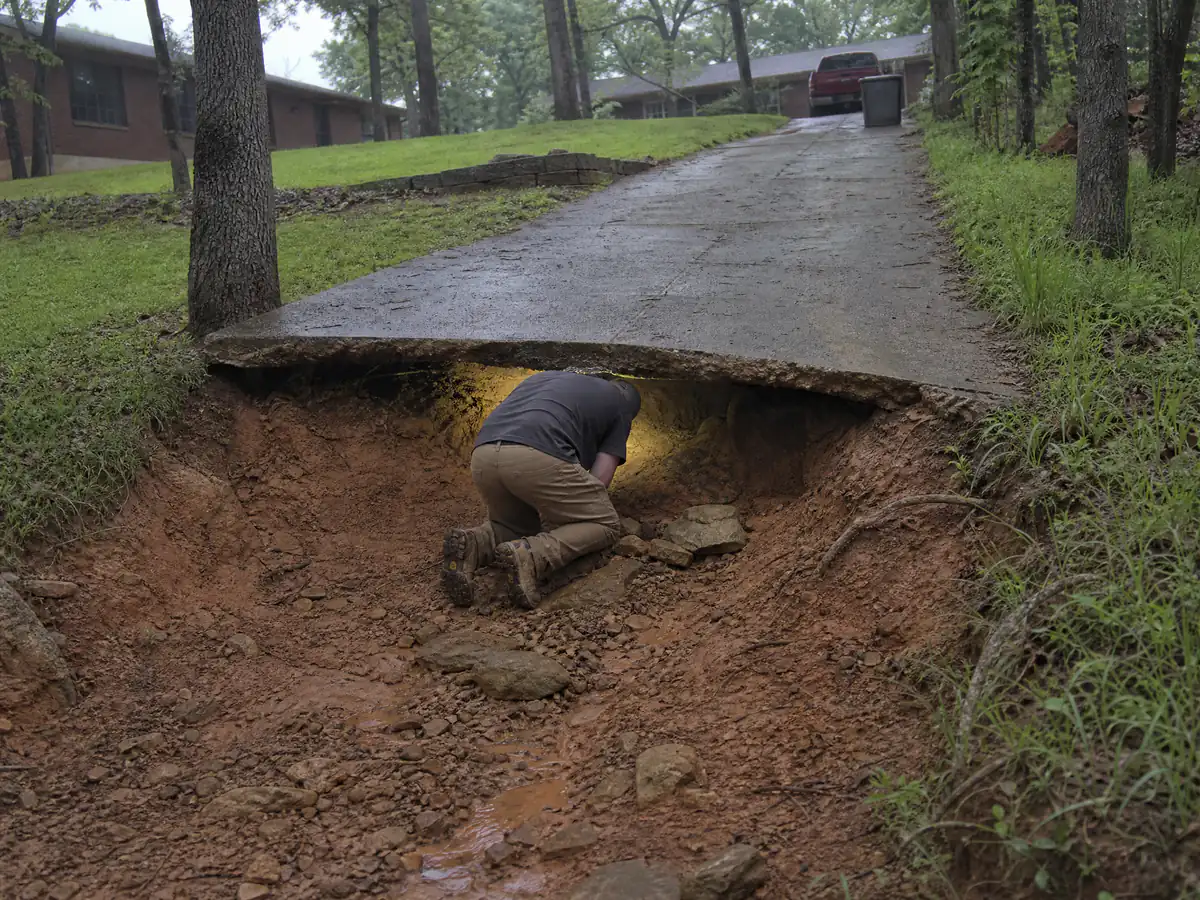
OKC Driveway Repair Co. repairs driveway washouts across Oklahoma City and the hillside lots of Edmond and the north metro. Driveway washout repair means filling the void that water carved under the slab, rebuilding the support at the edge, and redirecting the water so it doesn’t happen again. Most washout repairs run $800 to $3,500. If you can see under the slab where cars drive, treat it as urgent and call for emergency driveway repair.
How a washout happens
A washout isn’t settling; it’s erosion. Water finds the edge of the slab and follows it, carrying soil and base stone away. The usual sources:
- A downspout emptying onto or beside the drive.
- A slope that sends yard or street runoff along the slab edge, common on sloped lots in Edmond and the north metro.
- A broken water or sewer line under the drive, washing soil out from below.
- A culvert crossing on acreage drives in places like Choctaw and Piedmont, where storm flow cuts around the pipe.
Oklahoma City gets its heaviest rain in spring and early summer thunderstorms, and a single storm can move a lot of soil. The concrete spans the hollow for a while, so the first sign is often a crack running parallel to the edge a few inches in. Then a corner drops, often during or right after a storm.
How we repair it
- Probe and measure how deep and how far under the slab the void reaches.
- Find the water before pricing the fix. A repair that ignores the source fails at the next heavy rain.
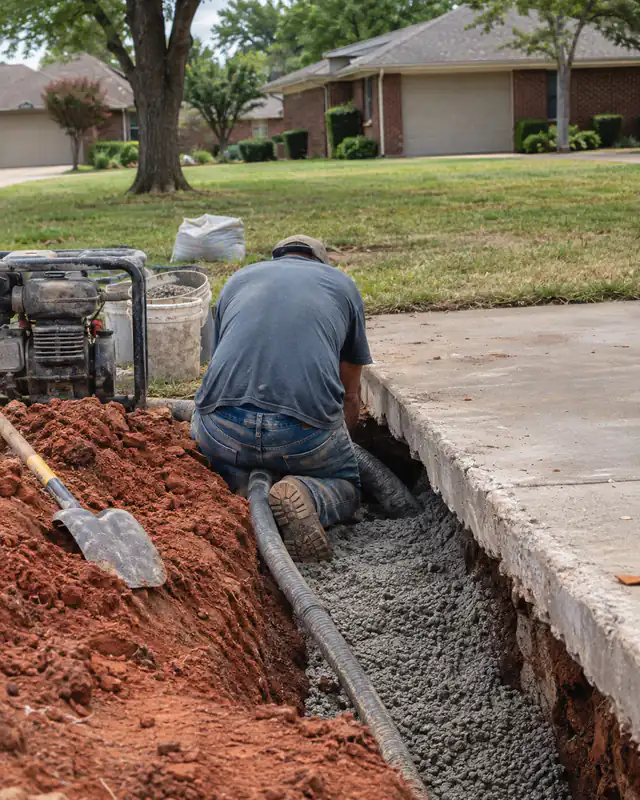
- Fill the void with material that won’t wash out: expanding polyurethane foam for voids under an intact slab, flowable fill for large cavities, or compacted crushed stone where the edge is open.
- Re-support or replace the edge. An intact panel is lifted back to grade. A broken edge panel is saw-cut out and re-poured with dowels and a thickened edge.
- Seal the joints and the edge crack so surface water can’t get back in.
Loose dirt shoveled into the hole is the most common DIY fix, and it washes out with the next storm.
The water is the repair
Every washout quote includes the drainage work:
- Downspouts extended or piped underground to discharge well away from the drive.
- Grading reshaped so runoff crosses the drive or flows away from it instead of along the edge.
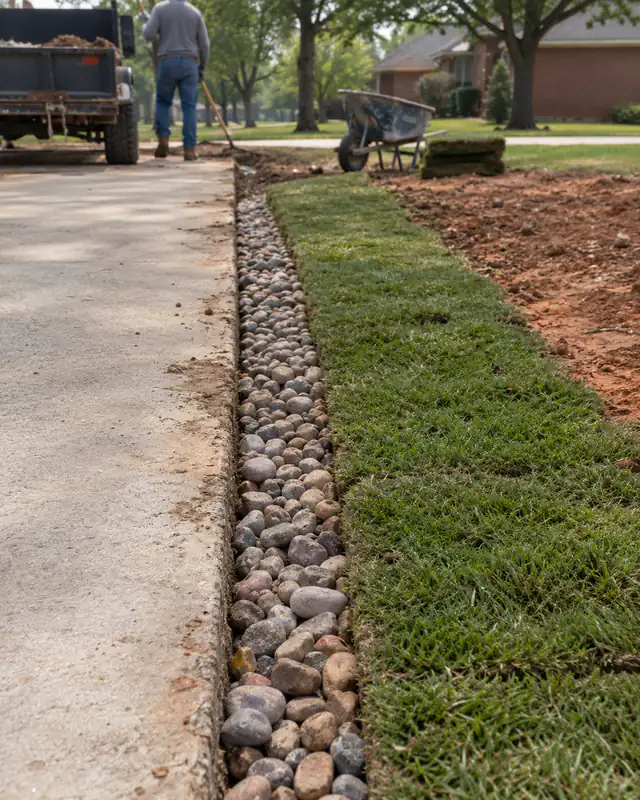
- A rock swale or channel where a slope has to carry water past the drive.
- A plumber or the utility if a leaking line is the source. We’ll point to it, and they fix the pipe before we fix the slab.
If the slab has sunk without a visible hollow, the problem may be soil settlement rather than erosion; see driveway leveling, and at the house, driveway sinking at the garage. Our guide to why driveways sink helps tell them apart.
What's included
- Void depth and reach probed and measured
- Water source traced: downspout, slope, pipe or culvert
- Void filled with foam, flowable fill or compacted stone
- Undermined edge rebuilt or the edge panel replaced
- Broken edge panels saw-cut and re-poured with dowels
- Downspouts extended or piped away
- Grade or a rock swale shaped to carry runoff away
- Joints and edge cracks sealed against water entry
Signs of a driveway washout
- A hollow you can reach into under the slab edge
- An erosion channel running alongside the drive
- A crack parallel to the edge, a few inches in
- A corner or edge that sank after heavy rain
- Soil or gravel washed onto the street after storms
Not sure which side of the line yours is on? The free driveway damage assessment takes about two minutes.
DIY patch vs the cheapest bid vs a driveway done properly
Most failed OKC drives didn't fail because of the concrete. They failed because of what's under it and what was skipped. Here's what to look for on any quote.
| What matters | DIY patch | Cheapest bid | Done properly |
|---|---|---|---|
| Base | Patches over whatever is there | Native clay graded flat, little or no stone | Soft clay dug out; 4–6 in. compacted crushed stone |
| Concrete | Bagged mix, hand-mixed, no air | Spec not on the quote | 4,000–4,500 psi air-entrained ready-mix, in writing |
| Thickness | Whatever the bags cover | 4 in., often thinner at edges | 5 in. with thickened edges |
| Reinforcement | None | Mesh lying on the dirt | #3 rebar on chairs; dowels into old concrete |
| Joints | None | Tooled late or skipped | Saw-cut within 24 h to ¼ depth, ~10 ft apart; ½ in. expansion joints |
| Curing | Left to dry | Left to dry | Membrane curing compound; no cars for 7 days |
| Permit at the street | Skipped | Often skipped | Pulled per OKC Code §50-116 |
| Quote | — | One number, verbal | Written, itemized, per square foot |