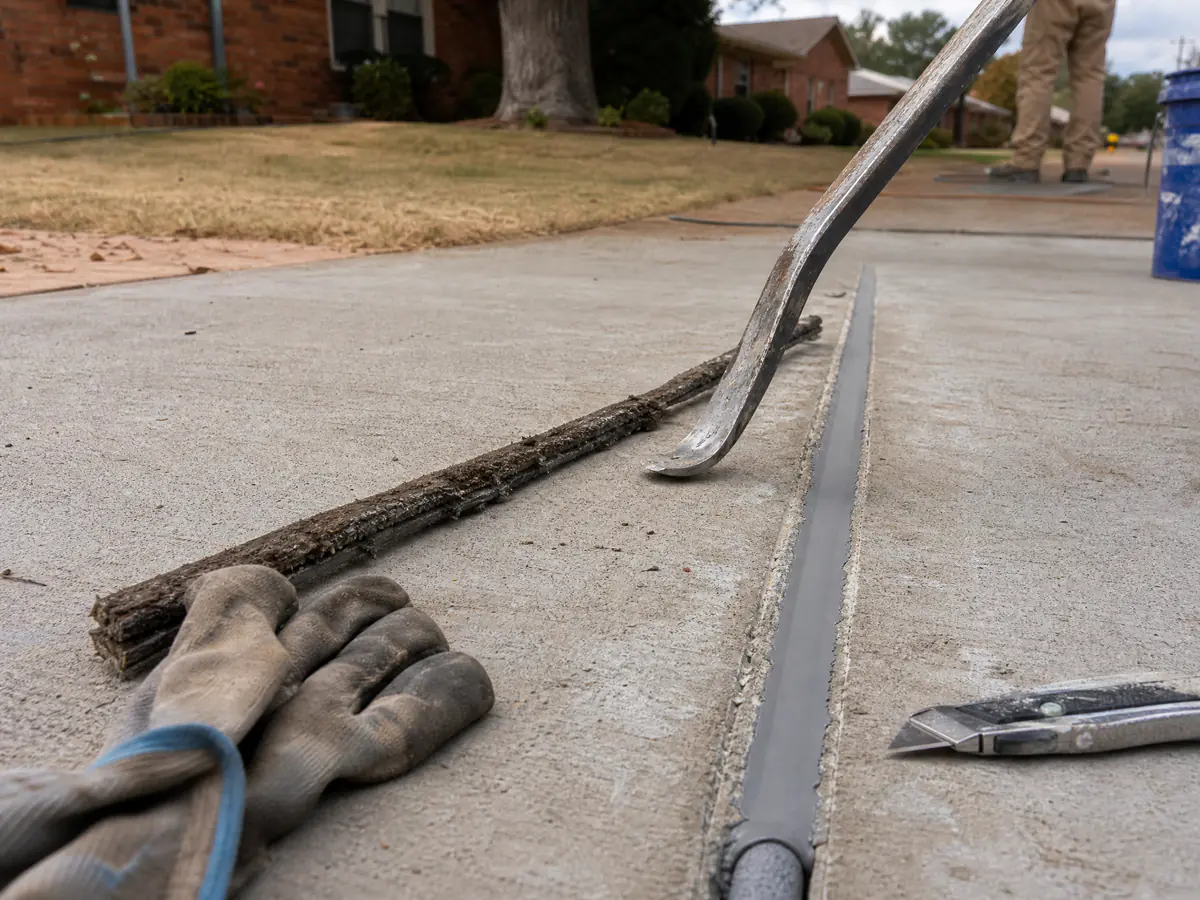
OKC Driveway Repair Co. replaces rotted and failing driveway expansion joints across Oklahoma City. Driveway expansion joint repair means pulling out old wood strips or failed caulk, setting closed-cell backer rod, and filling the joint with flexible polyurethane sealant. It costs about $3 to $6 per linear foot, and a typical two-car drive has 60 to 100 feet of joints, so most jobs run $250 to $600.
What expansion joints do
Concrete grows in heat and shrinks in cold. Expansion joints are full-depth gaps, about ½ inch wide, that let panels grow without pushing against the garage floor, the sidewalk or the street. Oklahoma City’s own sidewalk specification, Code §50-103, calls for ½-inch expansion joints for exactly this reason.
Oklahoma City is hard on them. The city’s record high is 113°F and it has seen as many as 63 days over 100°F in a single year; it also averages 71 days a year at or below freezing (NWS normals). When a joint fills with dirt and gravel, the panels have nowhere to go in summer, so the edges crush and spall. And every open joint lets rain into the clay base. Clay that soaks and dries over and over is what leaves voids under the slab and sinks panels.
How we replace them
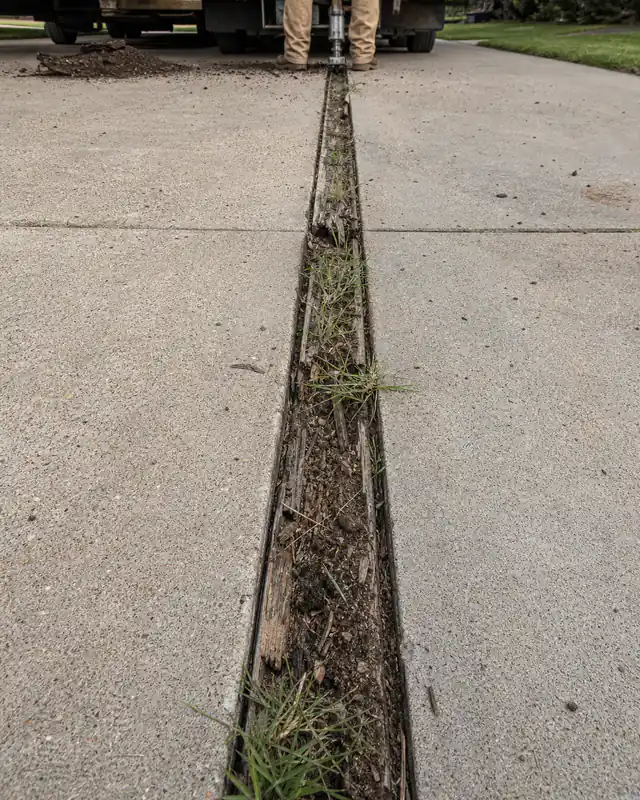
- Pull the old filler. Rotted wood, compressed fiber board and split caulk are cut and pried out, full depth where we can reach it.
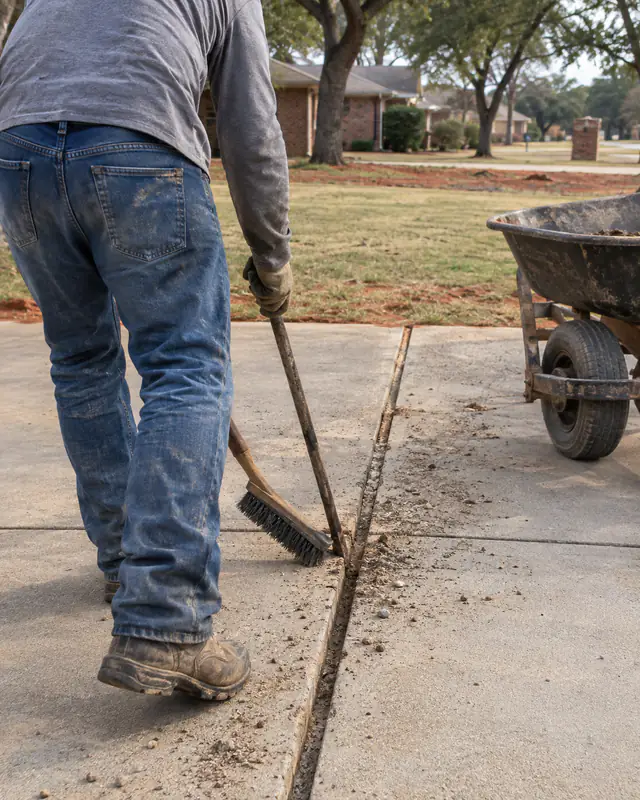
- Clean the faces. The joint walls are wire-brushed and blown clean down to sound, dry concrete so the sealant can bond.
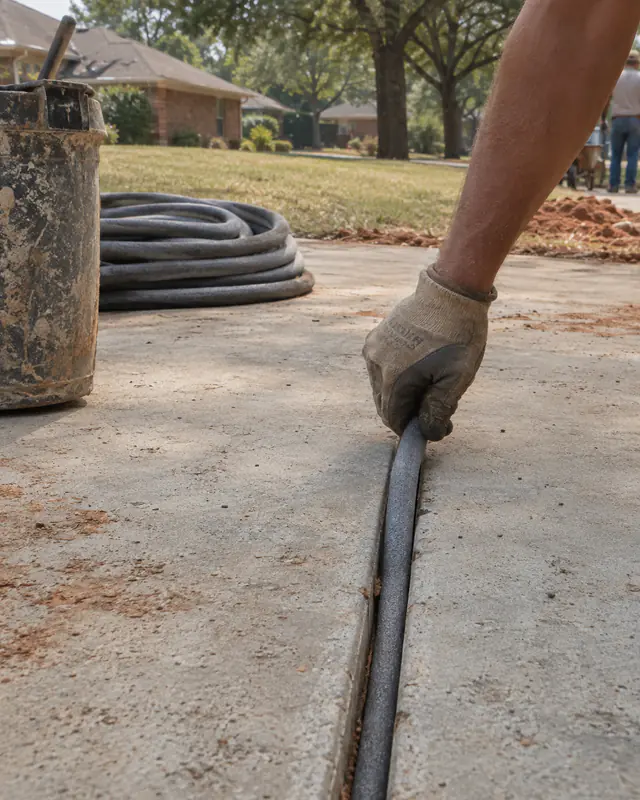
- Set backer rod. Closed-cell foam rod sized slightly larger than the joint is pressed in to the right depth. It keeps the sealant from bonding to the bottom so it can stretch.
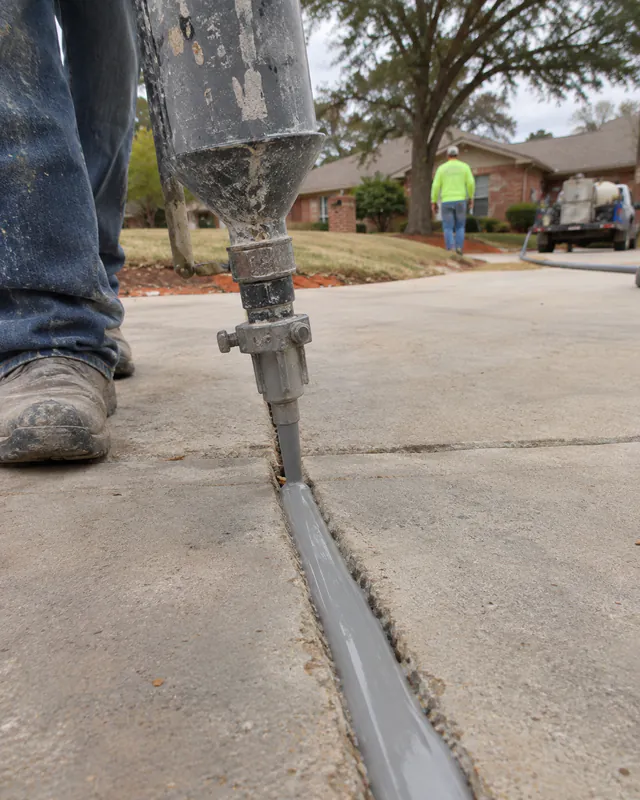
- Seal. Self-leveling polyurethane on flat drives, gun-grade on slopes, set slightly below the surface so tires and snow shovels don’t catch it.
- Fix chipped edges where the old joint let the concrete break, so the new sealant has a clean edge to bond to.
Cars can usually go back on the drive the next day.
Why not new wood
Redwood and cedar strips were standard in older metro drives, and some crews still use them. Wood holds water, rots within a decade or two, and leaves a channel that weeds and soil fill. Once it is packed with dirt, it can’t compress, and it stops working as an expansion joint. Polyurethane over backer rod sheds water, stays flexible through heat and cold, and can be touched up in minutes.
If the joint at your garage has a step in it, the panel has settled and needs leveling or replacement before the joint is sealed. Random cracks across panels are a separate job, covered on our driveway crack repair page, and the cost to fix cracks guide prices both.
What's included
- Every joint measured and listed on the quote
- Rotted wood and old sealant removed
- Joint faces cleaned to sound concrete
- Closed-cell backer rod sized to each joint
- Self-leveling polyurethane on flat joints
- Gun-grade polyurethane on sloped drives
- Sealant set slightly below the surface so tires don't pull it
- Chipped joint edges repaired where needed
Signs your expansion joints need replacing
- Wood strips rotted, crumbling or missing
- Weeds and grass growing in the joints
- Joints packed with dirt and gravel
- Panel edges chipping where the joint has closed up
- Old caulk split down the middle or peeled off one side
Not sure which side of the line yours is on? The free driveway damage assessment takes about two minutes.
DIY patch vs the cheapest bid vs a driveway done properly
Most failed OKC drives didn't fail because of the concrete. They failed because of what's under it and what was skipped. Here's what to look for on any quote.
| What matters | DIY patch | Cheapest bid | Done properly |
|---|---|---|---|
| Base | Patches over whatever is there | Native clay graded flat, little or no stone | Soft clay dug out; 4–6 in. compacted crushed stone |
| Concrete | Bagged mix, hand-mixed, no air | Spec not on the quote | 4,000–4,500 psi air-entrained ready-mix, in writing |
| Thickness | Whatever the bags cover | 4 in., often thinner at edges | 5 in. with thickened edges |
| Reinforcement | None | Mesh lying on the dirt | #3 rebar on chairs; dowels into old concrete |
| Joints | None | Tooled late or skipped | Saw-cut within 24 h to ¼ depth, ~10 ft apart; ½ in. expansion joints |
| Curing | Left to dry | Left to dry | Membrane curing compound; no cars for 7 days |
| Permit at the street | Skipped | Often skipped | Pulled per OKC Code §50-116 |
| Quote | — | One number, verbal | Written, itemized, per square foot |